
The Google AdWords click fraud settlement affected a broad class of U.S. advertisers. Understanding who qualified — and what options remain after the settlement's conclusion — is important for any advertiser who suspects they have been or are being overcharged for pay-per-click advertising.
Who Was in the Settlement Class?
- Class member (legal definition)
- In a class action, a “class member” is any person or entity that falls within the court-approved class definition and is therefore bound by (and entitled to benefit from) the settlement, unless they opted out during the designated period.
The AdWords click fraud settlement class included:
- All persons and entities in the United States who purchased keyword advertising through Google's AdWords program
- Advertisers who were charged for clicks during the defined class period (generally 2002–2005, though exact dates were set by the court)
- Both individual advertisers and businesses of any size
Who Was Excluded
Certain categories of advertisers were excluded from the class:
- Advertisers who timely opted out of the settlement during the notice period
- Google and its subsidiaries, officers, and directors
- The presiding judge and their immediate family
- Advertisers whose accounts were exclusively outside the United States
What Did Class Members Receive?
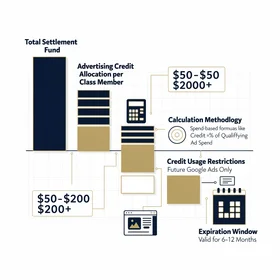
Eligible class members who submitted valid claims received advertising credits for future Google AdWords spending. The credit amount was calculated proportionally based on each advertiser's total AdWords expenditure during the class period. Key details:
- Credits, not cash — the primary form of compensation was Google advertising credits, not direct monetary payments
- Proportional allocation — higher spenders received larger credits, but all valid claimants received something
- Expiration — credits had a use-by deadline set by the settlement terms
- Named plaintiffs — the lead plaintiffs received modest incentive awards (typically $2,500–$10,000) in addition to their proportional share
Best For: Who Was This Settlement Ideal For?
The settlement structure meant that different types of advertisers experienced very different outcomes:
- Active advertisers who planned to continue using Google Ads benefited most, since they could immediately apply credits to ongoing campaigns
- Former advertisers who had stopped using the platform received credits they may never have used — an outcome many critics highlighted as a fundamental flaw in the settlement design
- High-volume spenders received proportionally larger credits but often found them small relative to their overall advertising budgets
- Small businesses received smaller credits in absolute terms but proportionally meaningful amounts relative to their budgets
Current Options for Overcharged Advertisers
While the original class action settlement is closed, advertisers who believe they are currently being overcharged by Google Ads have several avenues to explore:
1. Google's Internal Dispute Process
Google provides mechanisms for reporting suspected invalid clicks and requesting billing adjustments directly through the Google Ads platform. This is the fastest (though not always most effective) first step.
2. Individual Legal Action
Advertisers with significant evidence of overcharging may pursue individual claims. Note that Google's current Terms of Service include mandatory arbitration provisions, which may affect how disputes are resolved. See our settlement history page for how the class action compared to individual claims.
3. Regulatory Complaints
The Federal Trade Commission (FTC) and state attorneys general can investigate unfair or deceptive advertising practices. While regulatory action is slow, it can result in systemic changes that benefit all advertisers.
4. Industry Groups and Advocacy
Organizations like the Association of National Advertisers (ANA) and the Interactive Advertising Bureau (IAB) advocate for greater ad platform transparency and accountability.
5. Alternative Dispute Options
Beyond litigation, overcharged advertisers can pursue alternative paths: mediation through a neutral third party, binding arbitration (which Google's terms may require anyway), small claims court for amounts under your state's threshold, or filing complaints with consumer protection agencies. Each alternative has trade-offs in cost, speed, and potential recovery compared to formal litigation.
Risks, Limitations, and Downsides
Advertisers considering any legal action against Google should be aware of several practical realities:
- Mandatory arbitration — Google's current terms may require disputes to be resolved through arbitration rather than in court, potentially limiting the ability to bring class actions
- Burden of proof — demonstrating overcharging requires detailed analytics data and often expert analysis to distinguish invalid clicks from legitimate but low-quality traffic
- Statute of limitations — claims for overcharging are subject to time limits that vary by jurisdiction and legal theory; delays in pursuing claims can be fatal
- Cost-benefit analysis — litigation and arbitration are expensive, and the potential recovery must justify the cost of pursuing a claim
This guide is provided for informational purposes only and does not constitute legal advice. Every advertiser's situation is different, and the information here may not apply to your specific circumstances. If you believe you have been overcharged by Google Ads, consult a qualified attorney. CJ Montgomery is a Washington-licensed attorney with experience in digital advertising disputes — visit montgomerylegal.net for consultation.